
Tang Ju (汤巨)
I pursued my Bachelor’s and Master’s degrees in the discipline of Aerospace Science and Technology at Beihang University, specializing in multiscale heat and mass transfer mechanisms, under the supervision of Prof. Dongsheng Wen and Prof. Jin Zhao.
In the course of my master’s studies, the primary focus of my research was on the domain of heat and mass transfer at micro/nano and macro scales, with a foundation in molecular dynamics simulations. The present study investigates the influence of thermal/mechanical/chemical properties at material surfaces on thermal protection, examining materials such as carbon knitted structures, phenolic resin composites, and hydrogels.
Education
09/2018 - 06/2022 B. E. in Aerospace Engineering
School of General Engineering, Beihang University (BUAA), Beijing, China
GPA: 3.41/4.0
09/2022 - 06/2025 M. E. in Aerospace Science & Technology
School of General Engineering, Beihang University (BUAA), Beijing, China
GPA: 3.7/4.0
Scientific Research
- Hyperthermal erosion of knitted graphene-nanoribbon sheet under atomic oxygen bombardment.
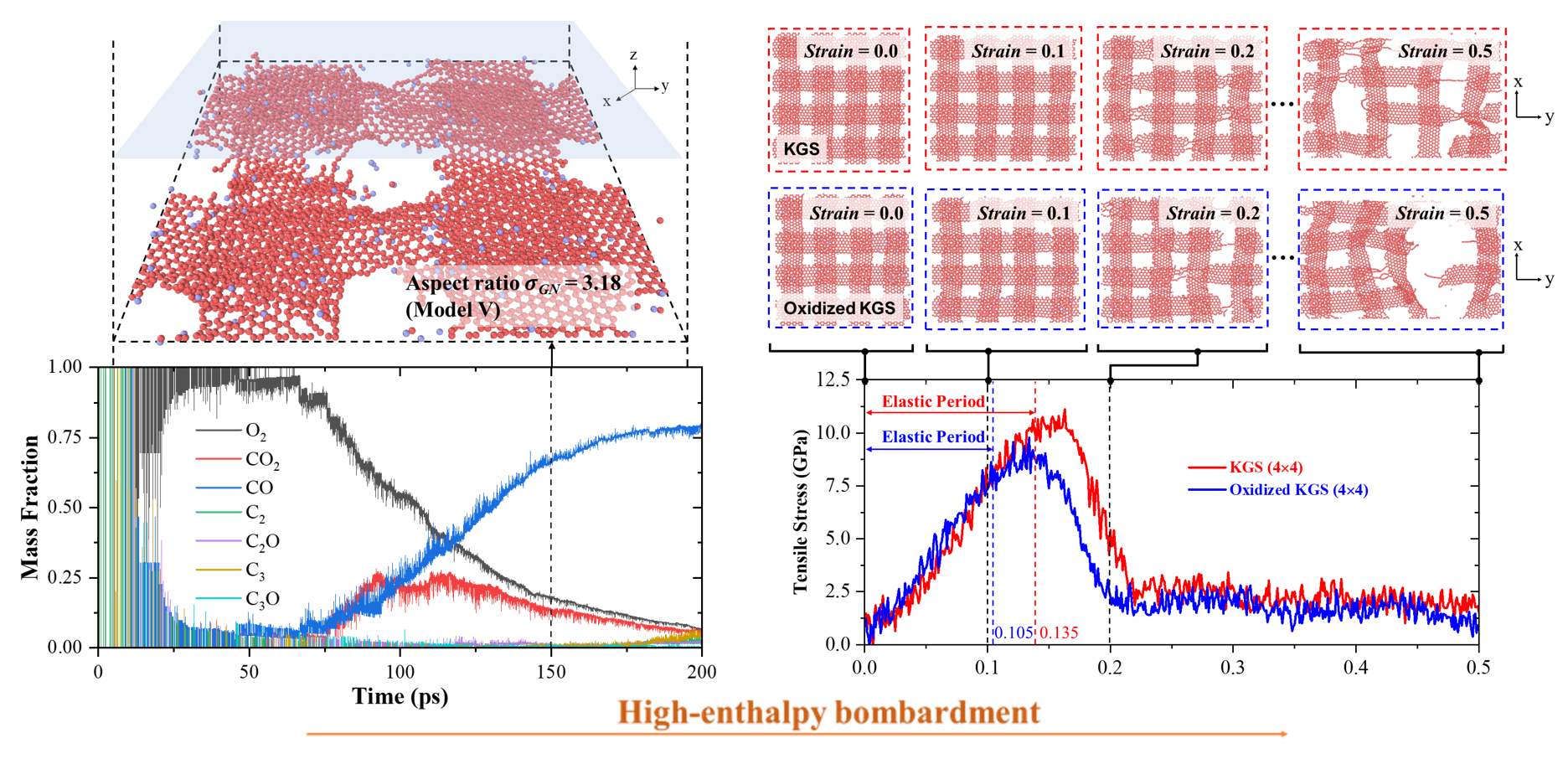
- With outstanding thermal, mechanical, and chemical properties, graphene has been proposed as a promising heat shield material for hypersonic applications. Knitted graphene composites have shown further improved properties, whose behavior under highly non-equilibrium hyperthermal conditions, however, is still unknown.
- This work investigates the hyperthermal erosion and mechanical behaviors of 2D and 2.5D knitted graphene-nanoribbon sheet (KGS) under hyperthermal atomic oxygen impact conditions using the Reactive Molecular Dynamics (RMD) method. The simultaneous analysis of the morphology evolution and gaseous products demonstrate that knitted structures possess improved anti-erosion and mechanical properties than those of the plain graphene, and the 2.5D knitted graphene structure shows better performance than those of 2D knitted ones. 2D structure porosity, ribbon aspect ratio, and 2.5D knitting volumetric porosity show significant influence on the hyperthermal erosion of materials under atomic oxygen bombardment, which suggests strategies for future optimization of knitted graphene properties.
- Multi-scale modeling of thermal and chemical kinetic characterization of composites during high-temperature pyrolysis by scale-bridging reactive molecular dynamics.
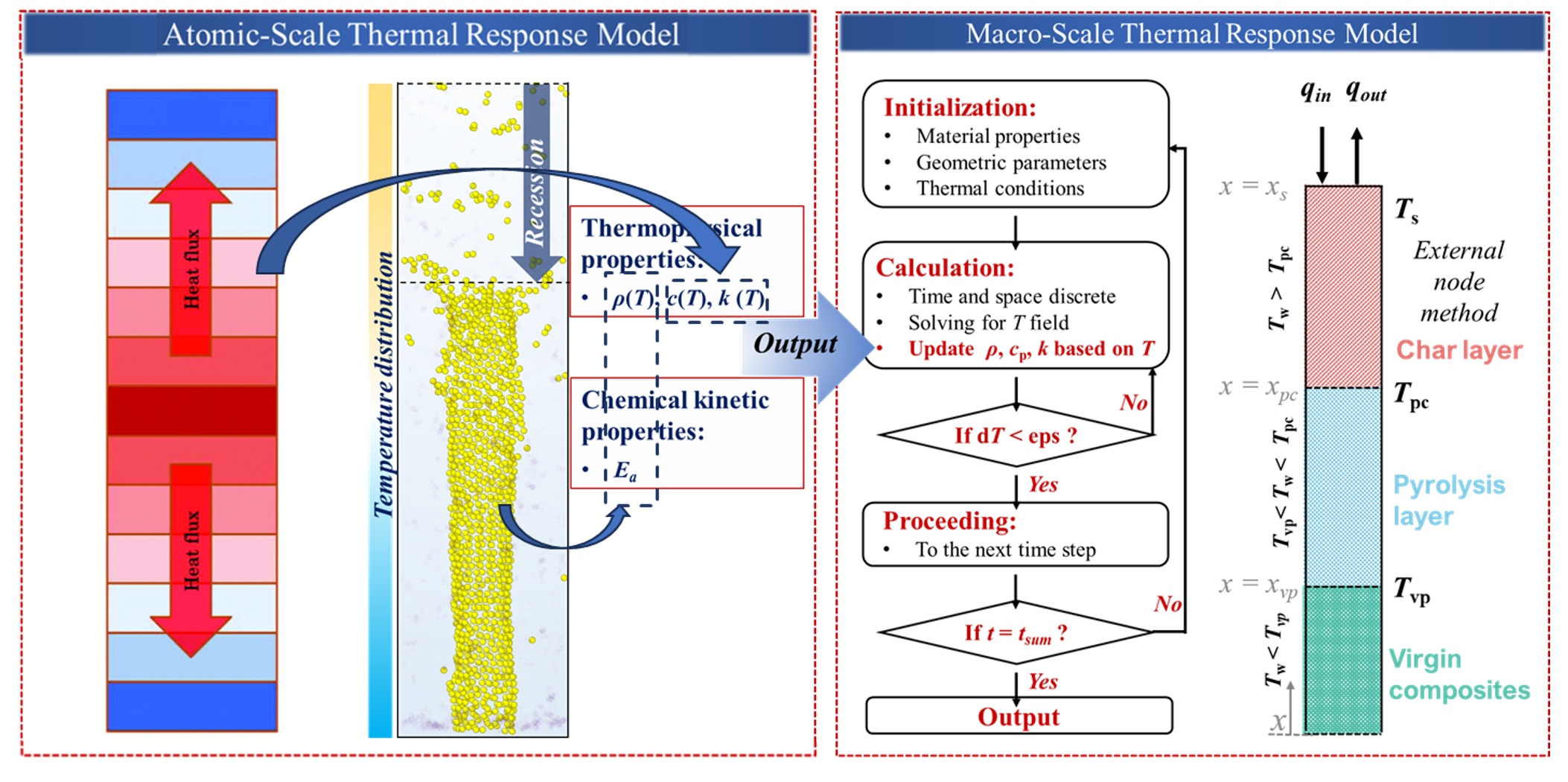
- Carbon nanotube reinforced phenolic resin composite shows great potential as thermal protection materials in the aerospace industry. To reveal its thermophysical characterizations and chemical kinetic mechanisms during high-temperature pyrolysis, a reactive molecular dynamics (RMD) simulation model is established to investigate the interfacial effect on the heat and mass transfer during the thermal pyrolysis of composites.
- A multiscale thermal pyrolysis model of carbon phenolic composites is further established with the varying thermophysical and chemical kinetic parameters input from the atomic-scale RMD simulation. The result suggests that the RMD investigation contributes both interfacial thermal pyrolysis mechanism revelation and comparable thermophysical characterizations, which can be the scaling bridge to upscaling analysis of composite thermal response, including the char layer evolution, during thermal pyrolysis at the macro scale. This multi-scale work provides an alternative approach of obtaining varying thermophysical properties during the high-temperature pyrolysis of composite materials with application in thermal response modeling at the macroscale.
- In-situ formation of surface” self-protective” graphitic layer on phenolic resin-based thermal protection composites.
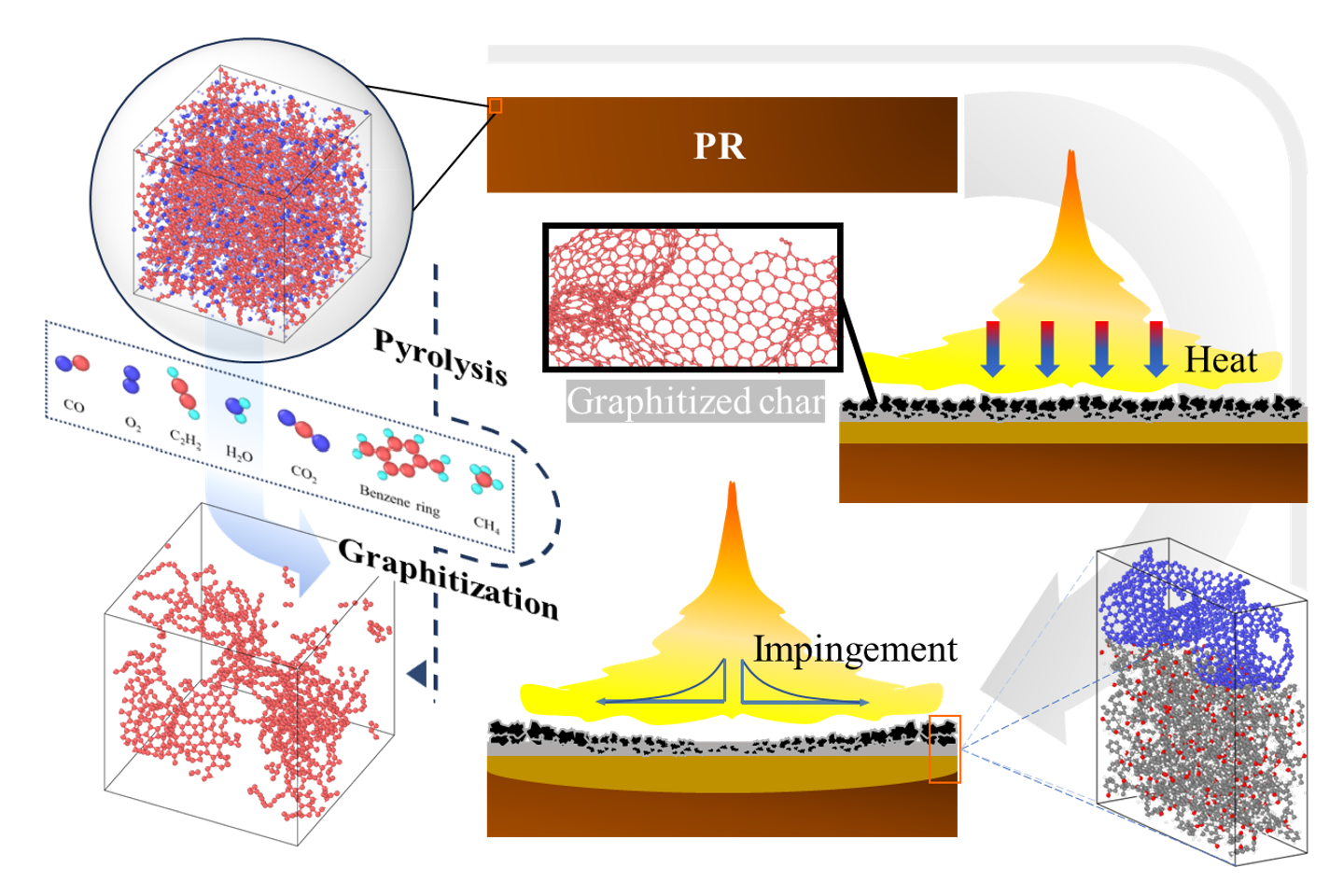
- For the first time, our study revealed that its outermost ablated surface demonstrated a distinct evolution behavior in terms of both the in-situ formation of “self-protective” graphitic layer and the radial redistribution of surface carbonaceous substances with different degrees of graphitization, leading to varied ablation resistance along the radial direction of the PR board.
- In addition, the computational study investigates the ablation-induced graphitization and its influence on the ablative resistance of PR surface. It indicated that, at equivalent energy flux density, PR with graphitized structures exhibited improved thermal protection performance, which can be attributed to decreased thermal conductivity and increased density, leading to a reduced ablation recession rate. Such revelation provides an alternative route in the design of PR-based ablative materials with enhanced ablation resistance.
- Enabling Autonomous Moisture Harvesting and Cyclic Transpiration Cooling with MXene-LiBr Functionalized Hydrogels for Advanced Thermal Management.

- Hygroscopic hydrogels offer cyclic transpiration cooling, mitigating local heat accumulation in integrated flexible electronics. However, the low thermal conductivity of traditional hygroscopic hydrogels poses a major challenge in meeting growing heat dissipation demands in electronics.
- Hygroscopic capacity tests and molecular dynamics simulations reveal that the synergy between MXene and LiBr increases osmotic pressure and water diffusion rates, leading to more efficient moisture sorption. This highly thermally conductive hygroscopic hydrogel demonstrates efficient cyclic transpiration cooling, outperforming commercial heat dissipation films and conventional hygroscopic hydrogels, making it a promising candidate for advanced thermal management in electronics.
Skills
- Familiar with the use of professional software such as Matlab, Python, Fluent, LAMMPS, CATIA, etc., and supercomputing platforms.
- In-depth understanding of GCN neural networks, and skilled in Bayesian maximum entropy optimization algorithms.
- Has participated in the application of Software copyright registration, patents, and project bidding.
Honors
- • Beijing Outstanding Graduate in 2025.
- • National Postgraduate Scholarship in 2024.
- • Second Prize for Academic Scholarship in 2020.